
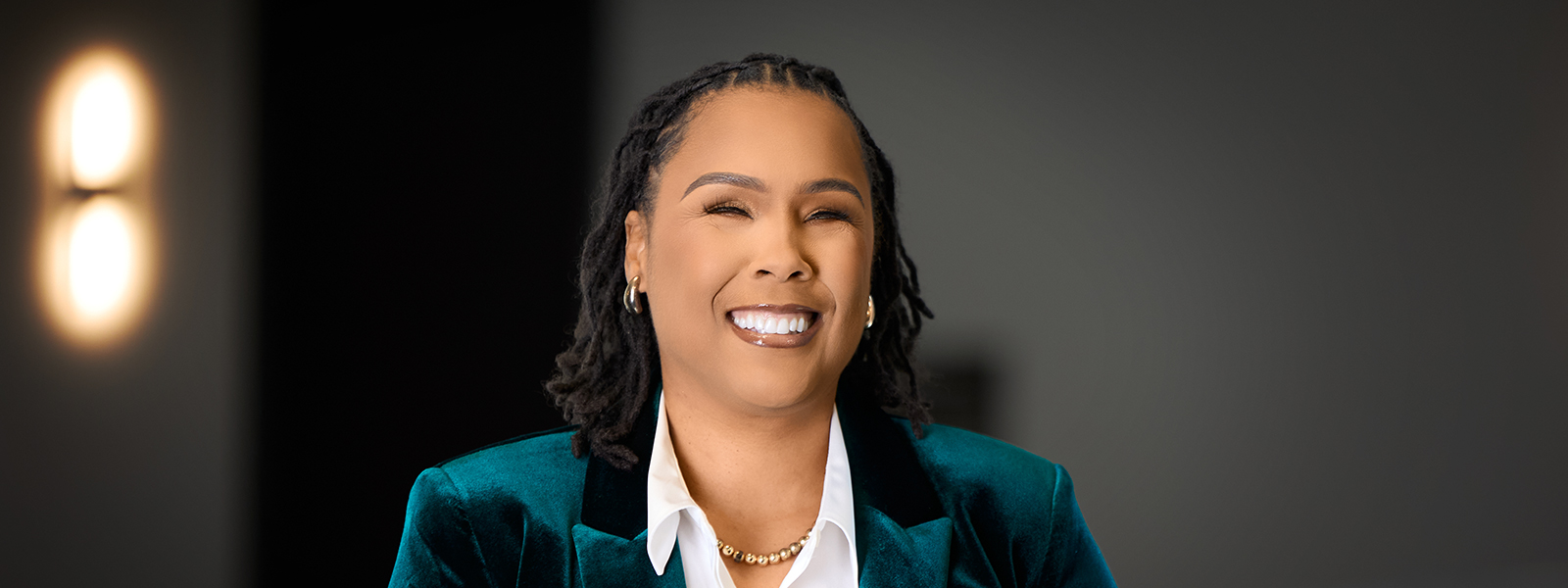
From Adversity to Advocacy
by Rachel Carlson
Tiffani Martin
MBA ’25
CEO, VisioTech
Dallas, Texas
Raised in a home where faith and determination went hand in hand, Tiffani Martin grew up believing that meaningful work begins with service. That belief stayed with her through life-changing health challenges, the founding of a mission-driven company and her decision to pursue a Master of Business Administration (MBA) at Baylor University’s Hankamer School of Business. Her story reflects a deep commitment to helping others access the tools and technologies they need to thrive in any situation.
Originally from Tallahassee, Florida, before relocating to Dallas in 1996, Martin was a multi-sport athlete, juggling AAU basketball, club volleyball and track year-round. Along with athletics, she had a strong love of entrepreneurship. She earned her undergraduate degree in Entrepreneurship from the University of North Texas.
“The entrepreneurial spirit that I have was embedded in me from my parents at a young age,” Martin said. “I learned everything I could about Microsoft Office, and at 12 years old, I started my own little marketing business creating business cards and brochures. Kids today probably don’t even know what brochures are.”
At 28, complications from type 1 diabetes caused the complete loss of her sight and required kidney and pancreas transplants, which she received at Baylor Scott & White in Dallas. During that same period, Martin married her husband, Richard. However, just two months later, she became seriously ill and was readmitted to the hospital. Unfortunately, she was experiencing kidney rejection.
From her hospital bed on the 14th floor of Baylor Scott & White, Martin created VisioTech, a company whose mission is anchored in the belief that technology should be a tool for empowerment, not a barrier.
“VisioTech was really birthed out of pain,” she said. “Access to technology gave me back my independence and became my livelihood. I wanted to build something that would do the same for others.”
Encouraged by a friend to pursue graduate education and be a visible presence in academia, Martin began exploring MBA programs. Baylor quickly rose to the top of her list. While other programs focused on her disability rather than her intellect – questioning, for example, how a blind student could code – Baylor stood apart for recognizing her potential, not her limitations.
“When I met with Baylor, the first thing they asked was, ‘What do you need in order to succeed?’ And boom – I knew I had found home,” Martin said.
She was also amazed by Baylor’s efforts to increase accessibility across campus – including an inclusive science lab for blind and low-vision students.
“To me, that means you’re sensitive to what’s going on in the world right now,” she said. “In addition to the Christian values, the environment, the staff, students – it instantly felt like home.”
As Martin’s vision grows for VisioTech, she is shifting focus for her company toward accessibility in artificial intelligence (AI). Her MBA concentration in cybersecurity was a strategic move to help her learn more about AI governance and advocate for inclusive technology.
“We’re really focused on helping companies build AI products that are inclusive for all persons – persons with disabilities, persons from marginalized groups, Black and brown,” Martin said. “I think it’s necessary right now to ensure that we have ethical and responsible AI for everyone. These are my hopes for the future.”
Building on that mission, Martin is now pursuing a PhD through The PhD Project – an award-winning nonprofit that promotes diversity in the workforce, especially in academia and corporate leadership. Despite initial doubts about her ability to succeed in a doctoral program, she found confidence through the encouragement of retired Baylor professor Timothy Kayworth, PhD.
“He really empowered and uplifted me,” she said. “He assured me that I absolutely have the capabilities and talent to go through a program.”
Throughout her time at Baylor she encountered numerous faculty and staff members like Kayworth who impacted her journey.
“I really think Baylor has a one-of-a-kind faculty and staff,” she said. “Professor Nick Simmons inspired me to really look into cybersecurity and was always there to answer all my questions. Sammy Victor, whom I worked with in accommodations, always inquired about my insight and experience to help other students. Every time I have encountered a faculty or staff member, it has been remarkable. Truly transformative. They’ve all helped me out to get to the next step.”
During her time at Baylor, Martin’s work gained recognition from Black Enterprise Magazine, the Governor’s Committee on People with Disabilities and the Dallas Business Journal. However, she views these accolades as just the beginning, using them as platforms to elevate the voices of the communities she represents.
“There is an added responsibility on my shoulders, but I welcome that,” she said. “If God is blessing me to touch and impact on this level, then it’s for a reason.”
At Baylor, Martin found not only an incredible graduate education but also a sense of affirmation.
“Baylor really leans into the scripture about being the salt of the earth,” she said. “They are developing Christian leaders to go out and impact the world. It’s the only place I’ve seen that produces top-tier talent grounded in Christian values.”
Although Martin has faced obstacles such as universities requiring GRE scores to get into a program, she wants to use the opportunity Baylor has given her by removing barriers like this to go out and transform the world.
“The GRE doesn’t really take into account some of the realities that people might face,” she said. “By removing the GRE requirement, Baylor granted me access to get into the program. I’m here to show that Baylor gave me an opportunity. I took that opportunity. I graduated with a 4.0 GPA. And now I’m going to try and change the world.”
Through her lived experiences, her entrepreneurial spirit and her commitment to advocacy, Martin is reshaping the conversation around accessibility, ability and inclusion. In doing so, she hopes to inspire others to go beyond her journey and achieve even greater heights.
“I’m hoping I can be a paradigm or hope for somebody else,” she said. “That they see what I did and go much, much farther.”