
Immersive Learning
by Rachel Carlson
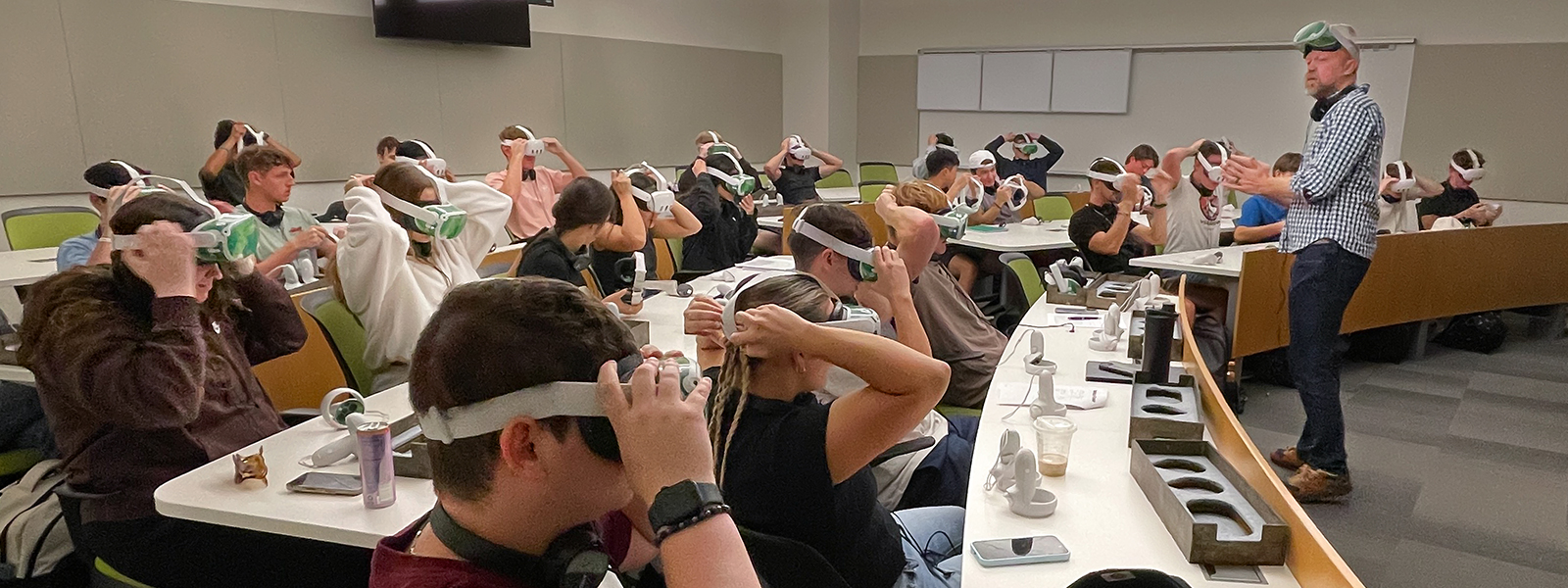
The Accounting and Business Law Department at the Hankamer School of Business (HSB) has introduced an innovative learning experience in its ACC 2304 – Managerial Accounting classes. By integrating virtual reality (VR) technology, the department offers students a unique way to understand job order costing, blending theoretical knowledge with immersive real-world applications.
Vice President and Provost Nancy Brickhouse, PhD, and previous HSB dean Sandeep Mazumder, PhD, attended one of the VR-enhanced classes led by faculty members Cari Edison, Michael Rodriguez and Haylee Beard. The classes featured VR headsets that took students on a virtual tour of Tesla’s manufacturing plant, allowing them to see firsthand the flow of product costs from raw materials to finished goods, providing practical insights into the manufacturing process.
“One of our key initiatives at the Business School is experiential and innovative learning,” Mazumder said. “Virtual reality and artificial intelligence will be key components in higher education moving forward, and it is great to see our faculty engaging with these technologies to help bridge the gap between theory and practice.”
Rodriguez, one of the faculty members leading this initiative, highlighted the value of the VR experience in providing students with context for the theoretical principles they learn in class.
“Most students at this stage of their lives have spent little, if any, time in a factory or manufacturing facility,” Rodriguez said. “This experience provides the students with tangible context about the theoretical principles we teach.”
Rodriguez believes this type of immersive learning is crucial, especially since arranging in-person tours of manufacturing facilities have been challenging due to logistical constraints.
“We explored whether using publicly available 3D content might be possible along with virtual reality headsets already owned by the university,” Rodriguez said. “Professors Beard, Edison and I reviewed prospective content and concluded that it would be a great way for our students to ‘see’ a real live manufacturing operation.”
The initiative began as a faculty collaboration and was piloted in the spring of 2024. The department has since invested in additional headsets to accommodate the large number of students taking the course. Rodriguez sees this as just the start of how VR and other technologies, such as artificial intelligence, can enhance business education.
“We are just seeing the tip of the iceberg with how we will be able to incorporate virtual reality technology into our accounting and business classes,” Rodriguez said. “We are truly excited for what it could offer.”
With this innovative approach, the department is leading the way in experiential learning by blending cutting-edge technology with traditional academic disciplines to create a more engaging and impactful educational experience for our students.