
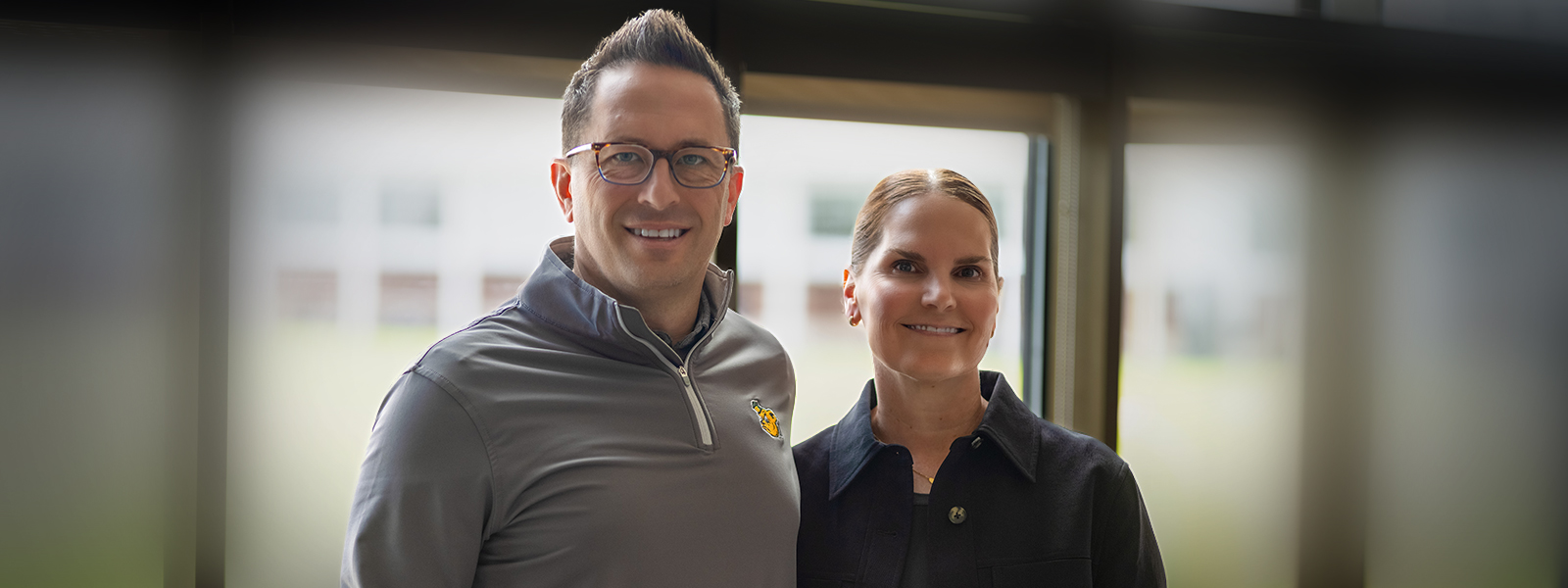
The Love of the Game
By Justin Walker
Colin Faulkner, BBA ’98
Chief Commercial Officer
Chicago Cubs
Jaime Faulkner, BBA ’98
President of Business Operations
Chicago Blackhawks
Chicago, Illinois
It’s a sunny April morning in Chicago. On the North Side, fans line up outside Wrigley Field for the Chicago Cubs’ 150th season. There is hope in the air, the kind that has defined Cubs baseball for generations. Across town, the Chicago Blackhawks are wrapping up their centennial season, reflecting on a century of hockey history while preparing for the franchise’s next era.
In many ways, these two iconic organizations tell the story of Chicago sports itself: tradition and transformation existing side by side. Quietly woven into both stories is the influence of two Baylor University graduates whose careers have helped shape modern sports business from behind the scenes.
Sports has never simply been about wins and losses for Colin and Jaime Faulkner. It has been about stewardship.
“The fans really own the franchise,” Jamie said. “We’re just the caretakers of it when we’re in these roles.”
That mindset has shaped nearly every chapter of the Faulkners’ careers. Today, Colin serves as chief commercial officer for the Chicago Cubs, overseeing revenue-generating operations ranging from ticketing and sponsorships to media through Marquee Sports Network. Jamie is president of business operations for the Blackhawks, leading a sweeping transformation of one of the NHL’s Original Six franchises.
But long before they helped shape two of Chicago’s most recognizable sports brands, they were Baylor students brought together through a setup that almost paired them with different people entirely.
The couple first met at Baylor in the late 1990s through a double date arranged by a Baylor professor. Ironically, Jamie and Colin were not initially paired together. But by the end of the evening, they had gravitated toward one another instead.
A few days later, Colin asked Jamie to dinner at Ninfa’s in Waco. From there, their relationship quickly grew into a partnership that has now spanned decades, family life and two remarkable careers in professional sports.
They married three days after graduating from Baylor and began building careers that would eventually place them among the most influential executives in professional sports.
Their paths into sports, however, were anything but conventional.
Colin’s journey began with the Dallas Burn, Major League Soccer’s Dallas franchise, before moving to the Texas Rangers and Dallas Stars organization, where he spent a decade growing through ticketing, marketing and sales leadership. Eventually, a call from the Cubs presented an opportunity that was difficult to ignore.
“I just decided to get outside my comfort zone and take a little bit of a risk,” Colin said.
Jamie’s route was even more unconventional. After graduating from Baylor, she joined Arthur Andersen and helped build a sports consulting practice centered on data and analytics before continuing that work at KPMG. Early in her career, she was determined to become the youngest partner at KPMG. But her life took a different path.
After the birth of their first child, Jamie made the decision to step away from the workforce and become a stay-at-home mom. Over the next eight years, she focused on raising their children while occasionally taking on part-time consulting projects that allowed flexibility around family life.
What could have looked like a career pause became the foundation for her biggest professional breakthrough.
As the Faulkners relocated to Chicago following Colin’s move to the Cubs, Jamie consulted on a concessions and hospitality project for the Cubs. That work led to a conversation with Levy Restaurants CEO Andy Lansing, who recruited her to build a strategy and analytics capability within the organization.
That effort eventually became E15 Group, now one of the premier strategy and analytics firms in sports and entertainment.
“The idea behind E15 was twofold,” Jamie said. “One, it was how do we enable Levy Restaurants with analytics so they could be better partners for their sports teams and operate better. And the second was we had a lot of clients that still wanted to work with us.”
Her work placed her behind the scenes at some of the world’s largest sporting events, from Super Bowls to the Kentucky Derby. Yet one of her favorite memories came during the Cubs’ magical 2016 World Series run.
As the Cubs battled through the postseason, a superstition emerged involving Levy’s chocolate cake. After players and executives ate slices during a tense World Series game and the momentum shifted in Chicago’s favor, the dessert became a good-luck ritual. When the series moved back to Cleveland, Jamie coordinated cakes to be transported from Pittsburgh to Progressive Field before Games 6 and 7.
“When we went into rain delay, everybody’s eating cake,” Jamie said. “We obviously win the World Series in 2016. And I never want to eat chocolate cake again in my life.”
For Colin, the World Series remains one of the defining moments of his career. But another project stands out for its impact on the Cubs fandom.
“The obvious answer is the 2016 World Series,” he said. “But I really think being a part, and a very small part, of helping save Wrigley Field is something I take a lot of pride in.”
The project to restore Wrigley Field was far more than a renovation. It was an effort to preserve one of baseball’s most iconic landmarks while modernizing it for future generations. This included structural repairs, expanded concourses, updated clubhouses and improved fan amenities, all while carefully protecting the historic character that has made Wrigley beloved for more than a century.
The challenge was balancing progress and preservation, Colin said. The Cubs were not simply upgrading a ballpark. They were safeguarding a place deeply tied to the identity of the franchise and the city.
Jamie carries that same long-term perspective into her work with the Blackhawks, where she has overseen sweeping changes to the organization’s business operations, analytics infrastructure and community development efforts. She helped lead acquisitions of additional hockey franchises, expanded development around the team’s practice facility and emphasized fan-centered decision-making throughout the organization.
That work extends beyond the arena walls. When the Blackhawks expanded their practice facility on Chicago’s West Side, Jamie and her team intentionally designed the project alongside the surrounding community rather than simply for it. The organization met extensively with nearby schools, senior living centers and neighborhood leaders to ensure the facility felt welcoming and accessible.
For all their professional success, though, both Colin and Jamie point back to the same foundation: faith, family and integrity.
“We’ve always said God first, marriage, kids and then jobs,” Jamie said.
Those priorities have guided them through demanding schedules, overlapping sports seasons and the constant pressures that accompany leadership roles in professional sports. Both describe marriage not as something that simply happens naturally amid busy careers, but as something requiring intentionality, communication and sacrifice.
“We’ve always supported each other by putting the other person first,” Colin said. “If both people are doing that, I think you’re in a good position.”
The balancing act has looked different throughout the years. There were seasons when Colin’s career demanded more of his time. There were seasons when Jamie stepped away from the workforce to raise their children. Now, there are nights when one is home while the other is traveling, opening a season or managing the demands of a major event.
Still, after decades in professional sports, the Faulkners continue to approach life the same way they did as Baylor students just beginning their journey together: as partners.
“We’ve been married longer than we’ve not been married,” Colin said.
Neither claims to have everything figured out. In fact, both openly admit they are still learning how to navigate the ever-changing rhythms of work, family and leadership.
“We’re making it up as we go and we’re figuring it out as we go,” Colin said. “Nobody has it all figured out.”
And perhaps that is what makes their story resonate beyond sports. Behind the packed stadiums, the historic franchises and the executive titles are two Baylor graduates who still prioritize faith, family and each other first, even amid the bright lights and constant demands of Chicago sports.