
Custom-Fit Consulting
by Russell Rankin
For more than a century, Standard Hat Works has crafted custom hats by hand. Its creations have topped the heads of country music legends, television personalities and even members of Air Force One’s flight crew. But while the company’s craftsmanship remained timeless, some of its business processes were firmly rooted in the past.
That challenge became an opportunity for four students at Baylor University’s Hankamer School of Business.
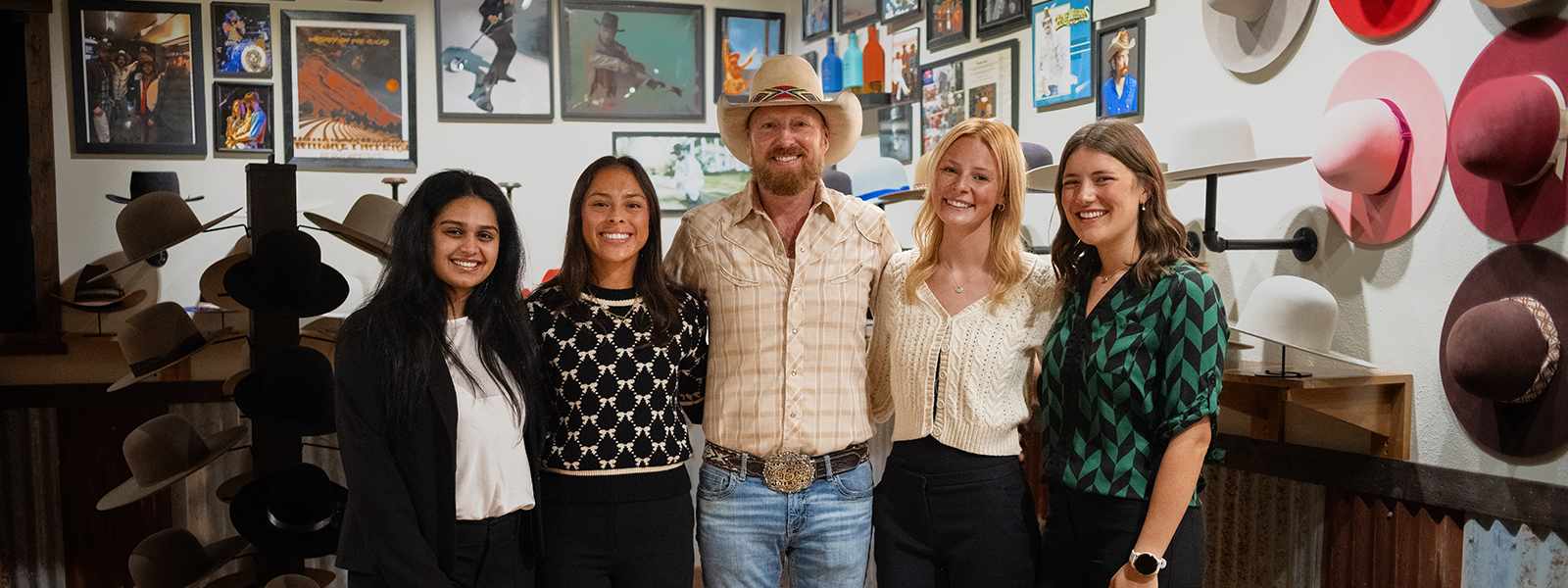
Kyla Pertuit, Rayne Schell, Alex Konicki and Safaa Lakhani earned top honors in Baylor’s Management Consulting course during the spring 2026 semester after developing a comprehensive digital growth strategy for Standard Hat Works, a Waco-based Texas institution founded in 1915.
Their success reflects more than a single-semester senior project (all four graduated in May 2026). It highlights the growing influence of Baylor’s consulting program, which has evolved into one of HSB’s strongest career pipelines.
Nine years ago, Baylor’s Management Consulting faced an uncertain future.
“The class was about to be shuttered,” said Professor Michael Wright, clinical assistant professor in the Department of Management, who teaches the senior-level course.
Originally designed as a capstone experience for Business Fellows students, the program has now been transformed into a launchpad for consulting careers. Through Wright’s class, student teams have consulted with more than 100 companies in the greater-Waco area.
“In the nine years since, we’ve moved the needle to where our goal is to have a third of all Business School graduates placed into consulting positions,” Prof. Wright said. “Consulting companies are telling me we’re becoming a target school.”
The numbers support that claim. According to data from the Baylor Career Center, more than 25 percent of HSB graduates accepted consulting positions between 2020 and 2025. During that period, 942 graduates launched careers with organizations including Deloitte, JPMorgan Chase, Credera, Oracle, Accenture, Dell Technologies, Goldman Sachs, KPMG, Protiviti and Sendero.
The course’s secret lies in its real-world approach. Student teams work directly with business leaders to diagnose challenges, develop solutions and deliver recommendations that clients can implement immediately.
For Standard Hat Works owner Cameron Morris, that practical focus made all the difference. Morris had participated in Baylor consulting projects before. Previous student teams had identified opportunities in digital marketing and helped the company acquire new marketing software.
As the student team met with Morris and learned about his business, the problem quickly became clear.
“They had software, but no implementation,” Pertuit explained. “They also had no social media strategy or ability to follow up on leads after events.”
The students saw an opportunity to create a complete marketing automation system that would allow Standard Hat Works to nurture leads, communicate with customers and maintain a consistent digital presence without adding significant demands on Morris or his staff.
“They worked hard to understand me as a client,” Morris said. “Their deliverables were very applicable and were presented in a manner we could implement immediately.”
The students developed a self-sustaining email marketing system, creating 16 outreach emails and customer engagement workflows that required minimal ongoing management.
“Cameron wanted a system that would work without him touching the emails,” Konicki said. “We made it very self-sufficient.”
The group also developed two customer events, three buyer personas to guide messaging and a collection of automation tools that helped transform existing market research into actionable marketing campaigns.
One of the most innovative aspects of the project involved helping the century-old artisan business harness artificial intelligence. Morris was intrigued by AI and wanted to know how it could benefit a company built on handcrafted products.
“Cameron makes custom cowboy hats, so AI isn’t going to take over his job,” Schell said. “But it could still help him.”
Using existing customer and market research, the team leveraged AI tools to create customized outreach plans, content calendars and social media strategies. By establishing a detailed brand context and set of prompts, they built a system that automatically generated content aligned with Standard Hat Works’ voice, audience and goals.
“All Cameron has to do is press ‘go,’” Schell said. “Every future prompt automatically knows Standard Hat Works’ voice, audience and schedule.”
The result was a practical roadmap for integrating AI into daily operations while preserving the company’s heritage and personal touch.
The students’ combination of technical expertise, business strategy and client empathy ultimately defined the project’s success.
“Yes, he wanted AI and yes, he wanted automation,” Konicki said. “But he also needed to know how to use it.”
When the team presented its recommendations, Morris knew he had something meaningful.
“Not only did the team do a lot of research to find resources that were beneficial; they explained how to effectively use the resources and utilize them on the simplest terms,” he said.
“He said his socks flew right out of his boots,” Lakhani said.
According to Prof. Wright, the project with Morris is another example of students applying classroom knowledge to solve real business challenges and creating solutions that make an immediate impact.
Every hat that leaves Standard Hat Works is shaped by hand to fit its owner. Similarly, HSB’s consulting students crafted a solution designed specifically for Morris and his business. The result wasn’t a one-size-fits-all recommendation, but a custom fit – one honoring a century-old tradition while helping position the company for its next chapter.