
Global Perspective, Lasting Impact
by Marty Duren
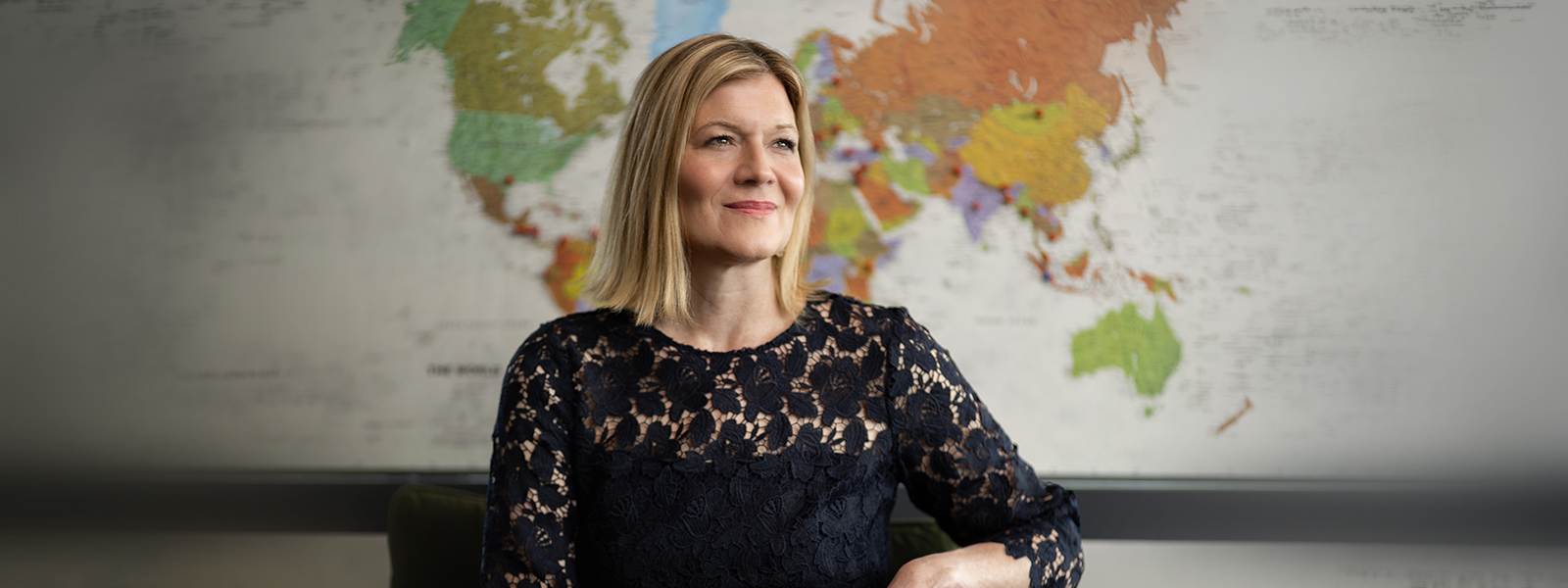
Professor Rachel Woods, the Hankamer School of Business Global Engagement Award recipient, says her passion for global leadership training comes from meaningful connections she has made with people across the world over the years.
“There is something beautiful and wondrous about international learning and exploration,” she said.
A clinical associate professor in the Department of Management, Prof. Woods loves equipping new and emerging leaders with the core skills needed to lead in the 21st-century reality of complex, interdependent teams.
One of the primary ways she does that is through Collaborative Online International Learning (COIL), an educational model that connects Baylor students with peers in other countries to work together on real-world projects. Rather than simply studying global business from a textbook, students gain firsthand experience collaborating across cultures, time zones and communication styles – the same challenges they are likely to encounter throughout their careers.
“Our students need hybrid/remote work skills and an understanding of global business, but it can also be disruptive to their traditional schedules,” Prof. Woods said. “Just as international experience has come to the Baylor classroom, no one needs to leave their town anymore to experience global business. It has come to us.”
Prof. Woods, as a recipient of the award, demonstrated outstanding commitment and innovation in integrating global engagement into courses within HSB. It includes recognition for inspiring students to embrace cultural diversity, developing a deep understanding of global business and cultivating cultural intelligence.
“In my Principled Leadership course, students are learning how to manage themselves and others for ethical behavior in a global work environment,” she said. “This includes gaining ethical awareness and managing common ethical issues in industry, while exploring what it looks like to lead virtuously.”
In Prof. Woods’ courses, COIL moves beyond theory into practice. Over the past seven semesters, Baylor students have partnered virtually with Kenyan students associated with Compassion International and with students at San Pedro College in Davao City, Philippines. Together, they work in cross-cultural teams to solve problems, navigate differing perspectives and develop the communication skills required in today’s global workplace.
Her professional background was instrumental in preparing her for COIL leadership. She has worked with women leaders from more than 25 countries virtually and in person, including Bhutan, Italy and Kenya. She led numerous virtual international development roundtables for women leaders starting in 2014. In 2024, she served as a panelist and breakout session facilitator at the WDN Africa Democracy Symposium in Dar es Salaam, Tanzania.
Prof. Woods enjoys learning alongside other Baylor professors who also adopt COIL programs into their courses.
“While we are not necessarily collaborating directly because we all teach different classes and manage different projects, these conversations provide a sense of community around COIL,” she said. “I’ve enjoyed being an active participant in faculty sessions where we can share best practices and learn strategies to meet common challenges and needs.”
An example of a student’s post-COIL reflection indicates Prof. Woods’ approach is working.
“The COIL project gave me real experience of what it looks like to work in a global business environment,” the student said. “I experienced how communication styles, expectations and ways of doing things can differ across countries. I also learned how important flexibility and patience are when collaborating across cultures.”
According to Prof. Woods, studying about leading across cultures from a textbook cannot compare to gaining experience working with teammates from another country.
“It is important that we help students grow in curiosity about other cultures and equip them with skills needed to navigate more diverse teams,” Prof. Woods said. “I believe that by adding this dimension to our courses, we can enrich leadership curriculum and prepare students to flourish in a global marketplace, and I hope to inspire them to have a deeper appreciation for cultures beyond our own borders.”