
Many of you may remember setting up a lemonade stand as a kid and selling each cup for a nickel or dime. I think those cups go for more these days. However, the point is every business starts with an idea- even if that idea is as simplistic as a lemonade stand.
The ideas of entrepreneurs have developed into the more than 27 million small businesses operating in the U.S. today. In this issue of the Baylor Business Review, we focus on the backbone of the American economy: small business.
Innovative entrepreneurs grasp the true meaning of “risk.” Successful small business leaders tend to treat risk as a two-sided coin: they identify and mitigate threats on one side while seizing and exploiting opportunities on the other side. Thanks to the rough wake of the global economic crisis, recent technological breakthroughs, better short-term access to specialized skills and intensifying global competition for skilled talent over the long term, there have never been more threats or opportunities confronting U.S. small businesses.
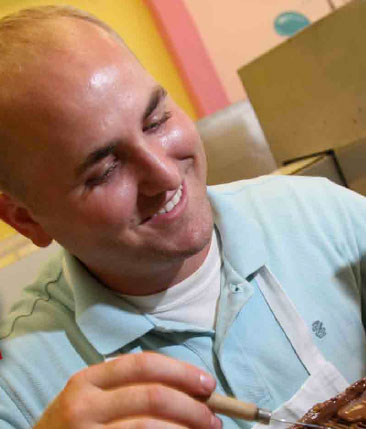
You might need a photobooth for your daughter’s wedding reception. Maybe you need to satisfy your sweet tooth. Or maybe you just need time to relax at a bed and breakfast. Today, more than 27 million small businesses operating within the U.S. are meeting a multitude of market needs. We caught up with Hankamer alumni who are involved with small businesses, which impact a variety of industries from food, hospitality, consulting, event services and recreation, to providing sustainable solutions for people in other countries.
When it comes to business operations, especially small business operations, one variable significantly affects the bottom line: the customer. Customers are an extremely powerful force. Is that customer content, overjoyed, disappointed or angry with the product/service offered? Chances are, whatever the reaction, they will let others know by word-of-mouth, whether it’s face-to-face or plastered all over the Twittersphere.
Studying abroad is always intended to provide students with an experience they couldn’t have had on campus or at home by immersing them in another culture. But for Baylor Entrepreneurship students, studying abroad wasn’t just about sightseeing or experiencing a new place. It was a fast-paced, two-week service project in Rwanda, Africa, that taught them more than any classroom, textbook or average study abroad program could.
The president of the company walks through his office one morning. He sees one worker texting, another talking on the phone and a third typing at her computer. He might wonder which one is hard at work. If he looked over their shoulders, he might discover that all of them are goofing off. Or he might find all three are toiling, each in his own way.
In 1971, The Coca-Cola Company aired its memorable commercial featuring people from across the world coming together and singing the song, “I’d Like to Buy the World a Coke.” Forty years later, Baylor professors Blaine McCormick and Van Gray are continuing to bring people together using a bottle of Coke, but they are also sharing business knowledge along the way.
Baylor University held its first Homecoming in 1909, and graduates are still returning to campus to celebrate more than a century later. Homecoming 2011 will be held on the weekend of November 4-5.
“Homecoming is a wonderful time to celebrate our roots and reconnect with friends,” said Terry Maness, dean of the Hankamer School of Business. “While alumni have taken different paths professionally, they all have the common bond of their days at Baylor and at Hankamer.”
In many ways, Ben Lamm was a typical Baylor student. The Finance and Accounting major (with a concentration in performance improvement technology) enjoyed spending time with his friends. He joined a fraternity and participated in extra-curricular activities. He studied, got to know his professors and went on a summer internship. But, unlike most Baylor students, Lamm returned from his internship as an entrepreneur.
Approximately 90 percent of businesses in the U.S. are family firms, ranging from small businesses to industry giants, like Walmart. Running a business isn’t easy, especially when family is added to the mix.
Each fall, Baylor University’s Institute for Family Business takes time to recognize firms whose families demonstrate a commitment to each other and to business continuity through its annual Texas Family Business of the Year Awards. These firms are responsive to the needs of their employees, communities and industries.
At first glance, the theory seems completely counter-intuitive. But when Steven Bradley started to really look at the question, the answer became surprisingly clear. The assistant professor of Management and Entrepreneurship wondered: how do resources help or hurt new businesses? His hunch was that for start-up businesses, too many resources could hinder more than they helped.
1973
Ed Crenshaw, BBA, serves as CEO of Publix Super Markets, the largest and fastest growing employee-owned supermarket chain in the U.S. For the 14th consecutive year, Publix was honored as one of Fortune magazine’s “100 Best Companies to Work For.” Publix was ranked No. 67 on the 2011 list and was one of only 13 companies to have made the list every year since its inception in 1998. Publix also ranked No. 20 on Fortune’s “Best Large-Sized Company” list, one of only four companies on the list with more than 100,000 employees. Publix also made the Fortune list of 15 companies to never have had a layoff.
How many angels can dance on the head of a pin?
Philosophers who argued over the presence of winged helpmates on Earth hundreds of years ago might be pleased to discover that angels walk among us, in what the ancients might view as a most unlikely arena: the marketplace.
Baylor Accounting Named in Public Accounting Report Rankings
Baylor University’s Accounting program received high rankings from Public Accounting Report’s (PAR) 29th Annual Survey of Accounting Professors, published in the independent newsletter’s November 2010 issue. After a one-year absence from the PAR lists, Baylor Accounting’s undergraduate program ranked No. 23 in the nation; its graduate program garnered honorable mention, just missing the top 25 list.
Launched in 2004, Vision Research Capital Management is a Dallas-based investment firm serving accredited and qualified investors. Its long-short equity partnership utilizes proprietary analytics and qualitative due diligence to identify and invest in domestic public companies.